New Horizons in Primordial Black Hole Physics
Plenary talk | CERN
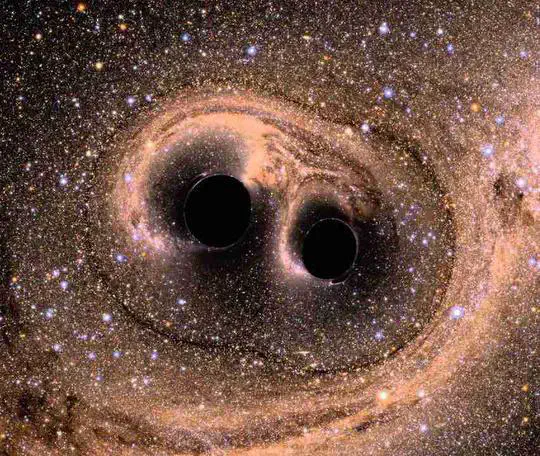 Primordial black holes across cosmic scales.
NEHOP 2026 brought together physicists working on primordial black holes, early-Universe cosmology and their observational probes. I was glad to contribute a plenary on connecting these signals across experiments.
Primordial black holes (PBHs) offer a particularly rich window onto the early Universe: the same large primordial curvature perturbations that collapse to form PBHs also generate a stochastic background of scalar-induced gravitational waves (SIGWs), while the PBHs themselves can later form binaries and merge, producing gravitational-wave signals in complementary frequency bands. In this talk, I explore how these signals can be connected across different experiments to probe PBHs over a vast range of masses. I begin with planetary-mass PBHs, whose formation is associated with micro-Hz SIGWs that could be targeted by future Lunar and Satellite Laser Ranging measurements. I then turn to sub-solar PBHs, discussing how mergers in ground-based interferometers and a nano-Hz SIGW background observed by pulsar timing arrays (PTAs) can arise from a common primordial origin. Finally, I switch gears to supermassive PBHs, whose binaries can produce chirping signals in PTAs, but whose abundance is strongly constrained by an effective field theory description of the high-redshift Lyman-alpha forest.
More information is available on the NEHOP 2026 event page, and the slides are available here.

Sokratis Trifinopoulos
Research Associate
Fundamental Physics at the intersection of Quantum Field Theory and Artificial Intelligence.